
Ask most people to picture a forklift and they will describe a counterbalance forklift: a seat, a mast at the front, two forks and a heavy rounded back end. It’s the most common lift truck in Canadian warehouses, factories and loading docks, and for good reason. It can unload a trailer, carry a pallet across the building and stack it on a rack without needing any special setup.
This guide explains how a counterbalance forklift works, the main types you’ll come across, where each one fits, and what to look for in an electric model.
Quick Answer
A counterbalance forklift is a lift truck that carries its load on forks in front of the front wheels and uses a heavy counterweight at the back to stop it tipping forward. Because there are no legs or outriggers under the load, it can drive straight up to a pallet, trailer or rack. They come in 3-wheel and 4-wheel sit-down versions, stand-up versions, cushion or pneumatic tires, and electric, propane or diesel power, with capacities from under 1,000 kg to well over 5,000 kg.
The idea is the same as a seesaw. The front wheels act as the pivot point, the load sits on the forks in front of them, and the truck’s own weight, concentrated in a counterweight at the back, sits behind them. The truck remains stable when the combined centre of gravity stays within its stability limits. Both the weight of the load and its distance from the front axle matter.
The counterweight is the large, heavy casting that forms the back of the truck. On propane and diesel trucks it is mostly solid iron. On electric trucks, the battery contributes to the truck’s overall weight and stability; the required counterweight and battery arrangement depend on the model.
When the forks pick up a load, the combined centre of gravity of the truck and load moves forward toward the front axle. If it moves past the axle, the truck tips forward. Everything about how a counterbalance forklift is rated and operated comes back to keeping that combined centre of gravity in the right place.
A counterbalance forklift rests on three points: the two front wheels and the centre of the rear axle, which pivots. Those points form what’s called the stability triangle. The truck stays stable as long as the combined centre of gravity stays inside that triangle. Lifting a load high, turning sharply, braking hard with a raised load or driving across a slope can all push it toward the edge, which is why speed and load height matter so much.

Every forklift has a capacity plate showing how much it can lift, at what height, and at what load centre. The load centre is the horizontal distance from the vertical fork face to the load’s centre of gravity. A truck rated at 2,000 kg at a 500 mm load centre can lift less than 2,000 kg if the load is longer and its centre sits farther out.
This matters when comparing quotes. Forklift ratings commonly use a 500 mm (19.7 in) or 600 mm (24 in) load centre, depending on the model and market. Confirm the stated load centre on each Noblelift model’s capacity plate before comparing quotes. Make sure you compare capacities at the same load centre, and check the plate for your heaviest real load at your highest lift. The Canadian Centre for Occupational Health and Safety’s guidance on load handling is a good refresher for operators.

Counterbalance forklifts are usually grouped by wheel layout, operator position, tires and power. Here’s how the main types compare:
| Type | Typical capacity | Best for | Noblelift examples |
|---|---|---|---|
| 4-wheel sit-down, electric | 1,600 to 8,000 kg | General warehouse work, docks and trailers | FE4P25-38GH and FE4P25-38A (Alpha), FE4P 60-80N |
| 3-wheel sit-down, electric | 800 to 2,000 kg | Tight spaces and frequent turning | FE3D 16-20N1, FE3R 08-12N |
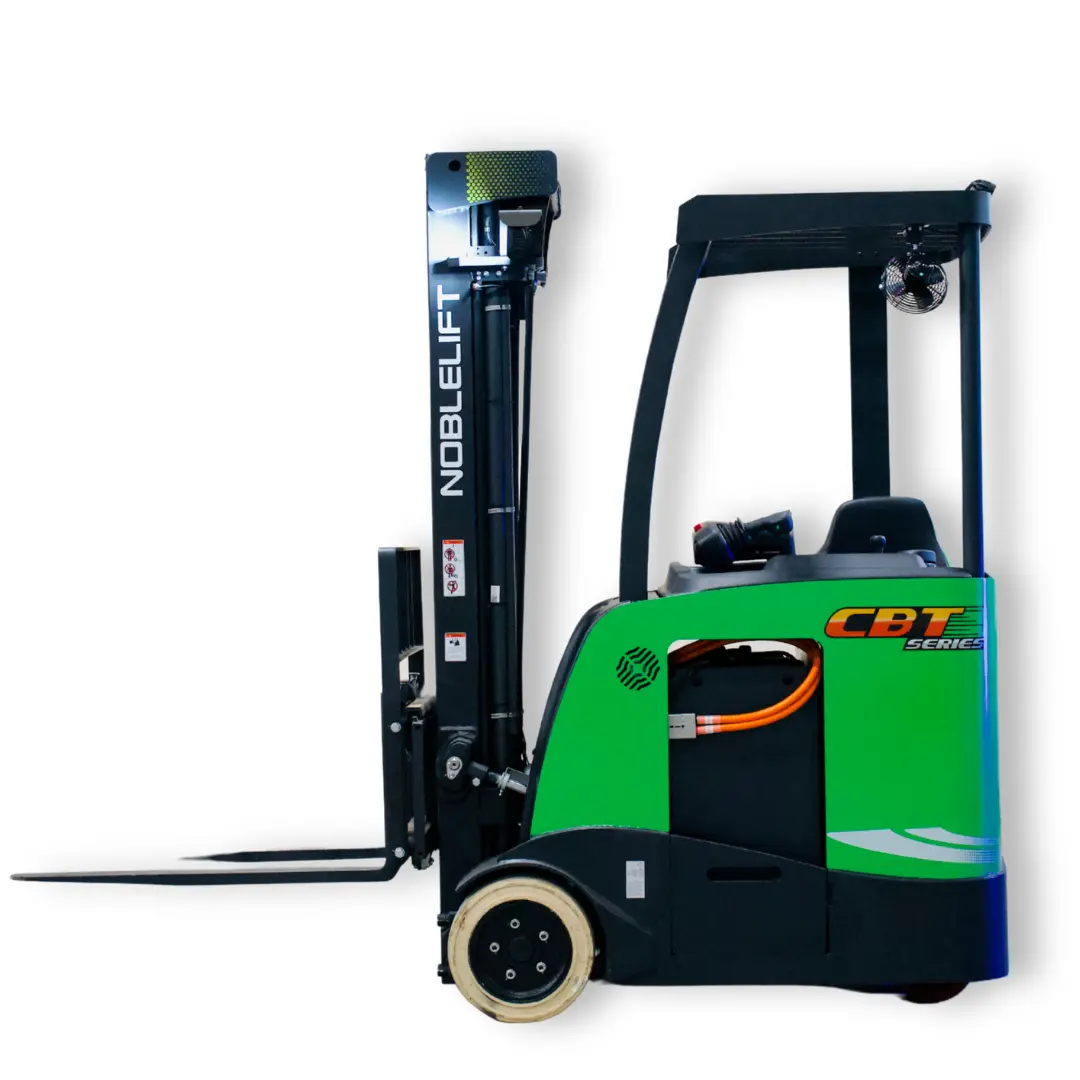
| Stand-up | 1,500 to 1,800 kg | Narrower aisles and on-and-off work | CBT15/18 |
| Cushion tire | 2,500 to 3,500 kg | Smooth indoor concrete floors | FE4P 25-35C |
| Pneumatic tire | 1,600 to 5,500 kg | Indoor and outdoor work, rough or uneven yards | FE4P25-38GH and FE4P25-38A (Alpha) |
A 4-wheel counterbalance forklift is the all-rounder. It has a wider base, handles higher capacities and copes better with ramps and dock plates. A 3-wheel forklift has a single rear wheel, or a pair of wheels close together, so it can turn in a much tighter circle. That makes it a good fit for crowded warehouses, manufacturing cells and trailer loading where space is tight, as long as loads stay on the lighter side. The FE3D 16-20N1 covers 1,600 to 2,000 kg, and the FE3R 08-12N covers lighter loads from 800 to 1,200 kg.
Most counterbalance forklifts are sit-down trucks, and a sit down forklift is the more comfortable choice for long travel distances. A stand-up counterbalance forklift like the CBT15/18 is shorter, needs less aisle space and is quicker to get on and off, which suits jobs where the operator keeps stepping down to scan, pick or check paperwork. Our stand-up vs. sit-down guide compares the two in detail.
Cushion tires are solid rubber bands pressed onto the wheel. They are compact and work best on smooth, dry concrete, so a cushion tire forklift like the FE4P 25-35C is built for indoor work. Pneumatic tires, either air-filled or solid pneumatic, are larger and grip better on rough, wet or uneven surfaces, so they are the choice for trucks that also work outside.
Because they need no special racking or floor setup, counterbalance forklifts turn up almost everywhere:
Their main limit is aisle width. Because the load is carried in front of the truck, a sit-down counterbalance forklift needs more room to turn and place a pallet than a reach truck. If your racking is tight, the 7 main types of forklifts guide explains when a reach truck or other narrow-aisle truck makes more sense.
An electric counterbalance forklift runs on a battery instead of propane or diesel. That means no exhaust, much quieter operation and fewer parts to service, making them a popular choice for indoor warehouse operations. With lithium batteries, they can also be topped up during breaks instead of having their batteries swapped.
Noblelift Canada’s electric forklift range covers most capacities:

Our lithium solution page covers charge times and battery life, and the lithium vs. lead-acid cost breakdown compares running costs over five years. Approximate CAD price: $45,000 to $80,000 for an electric counterbalance forklift with battery and charger, and $38,000 to $65,000 for a propane or diesel model.
Whatever you choose, operators must be trained and evaluated on the specific type of truck they use, in line with CSA B335:25 and your provincial regulator.
It’s a forklift that carries the load on forks in front of its front wheels and uses a heavy counterweight at the back to balance it. It’s the most common type of forklift, used for loading, moving and stacking pallets.
Because the weight at the back of the truck counterbalances the load on the forks. Without it, the truck would tip forward when it lifted anything heavy.
A counterbalance forklift carries the load in front of the truck and needs wider aisles, but it can work at docks, in yards and on trailers. A reach truck uses a retractable mast or fork carriage and support legs to work in narrower aisles and access higher racking. Most conventional reach trucks are intended for indoor, level-floor applications.
Yes. A 3-wheel forklift is a counterbalance forklift with a single rear wheel or pair of close-set wheels, which gives it a tighter turning circle for crowded spaces.
Yes, if it has pneumatic tires and suitable protection. Electric trucks with pneumatic tires handle yards and docks well, while cushion tire models are best kept indoors.
The right counterbalance forklift depends on your loads, lift heights, aisles and floors. Noblelift Canada can help you compare 3-wheel, 4-wheel and stand-up models and choose the right lithium battery for your shifts. Multi-site operators can ask about our national accounts program. Call +1 514-697-0117 or request a quote to get started.
