
A crew unloading floor-loaded freight with a hand pallet truck can significantly improve productivity by moving to a properly specced electric pallet jack, particularly as pallet weights, travel distances and daily pallet volumes increase. That gap is why the electric pallet truck is usually the first powered unit a growing operation buys, and the entry point to the seven main types of forklifts.
The trouble is that the term covers everything from a $7,000 CAD walkie for a retail backroom to a $50,000 end rider running 14 km/h across a cross-dock. Buy the wrong class and you either overpay for equipment you don’t need or risk premature wear and downtime from using an undersized truck in a demanding application.
A hand pallet truck is a hydraulic lever on wheels. The operator pumps the handle to raise the forks 85 to 100 mm, then pushes and pulls the whole load, all 1,500 kg (3,300 lb) of it, using body weight. A powered unit replaces both functions with motors. A traction motor drives the wheel, an electric pump handles the lift, and the operator only steers.
Throughput is the obvious change. Travel speed goes from walking pace with resistance to 5 to 6 km/h loaded on a walkie, and up to 14 km/h on a fast end rider like the PT 27/36RN. Injury exposure drops too, since manual pallet handling is a leading source of musculoskeletal claims in Canadian distribution and removing the push force removes most of that risk.
The change buyers don’t expect is the training obligation. A powered pallet truck is a powered industrial truck under CSA B335-15 (R2024), so operators need documented training and evaluation. CSA B335 is commonly referenced in Canada for lift-truck operator training, while specific occupational health and safety requirements and enforcement vary by province. A hand pallet truck has no equivalent requirement. Budget for the training time.
Six configurations cover almost every application. The dividing lines are operator position, travel distance and duty cycle.
The default. The operator walks behind or beside the truck, steering with a full-length tiller. Capacities run 1,500 to 2,500 kg (3,300 to 5,500 lb). Best for short runs, mixed duties and sites where you can’t spare aisle width for a platform. If the job also involves lifting to a rack beam, you want a walkie stacker or a reach truck instead. The PT20L-Li sits in this band at 2,000 to 2,500 kg.
Same walking operation, but the tiller is shortened and the chassis compressed to reduce the truck’s operating footprint and improve maneuverability inside trailers and sea containers. If your team spends its day inside trailers, this is the configuration that pays for itself. The PT20/25N short tiller runs 2,000 to 2,500 kg at 8 km/h, which adds up over a 16-metre run repeated all shift.

A fold-down or fixed platform lets the operator ride, so 50 to 150 metre travel cycles stop being a walking problem. The PRS200 is a 2,000 kg high-speed stand-on suited to long dock runs and staging.
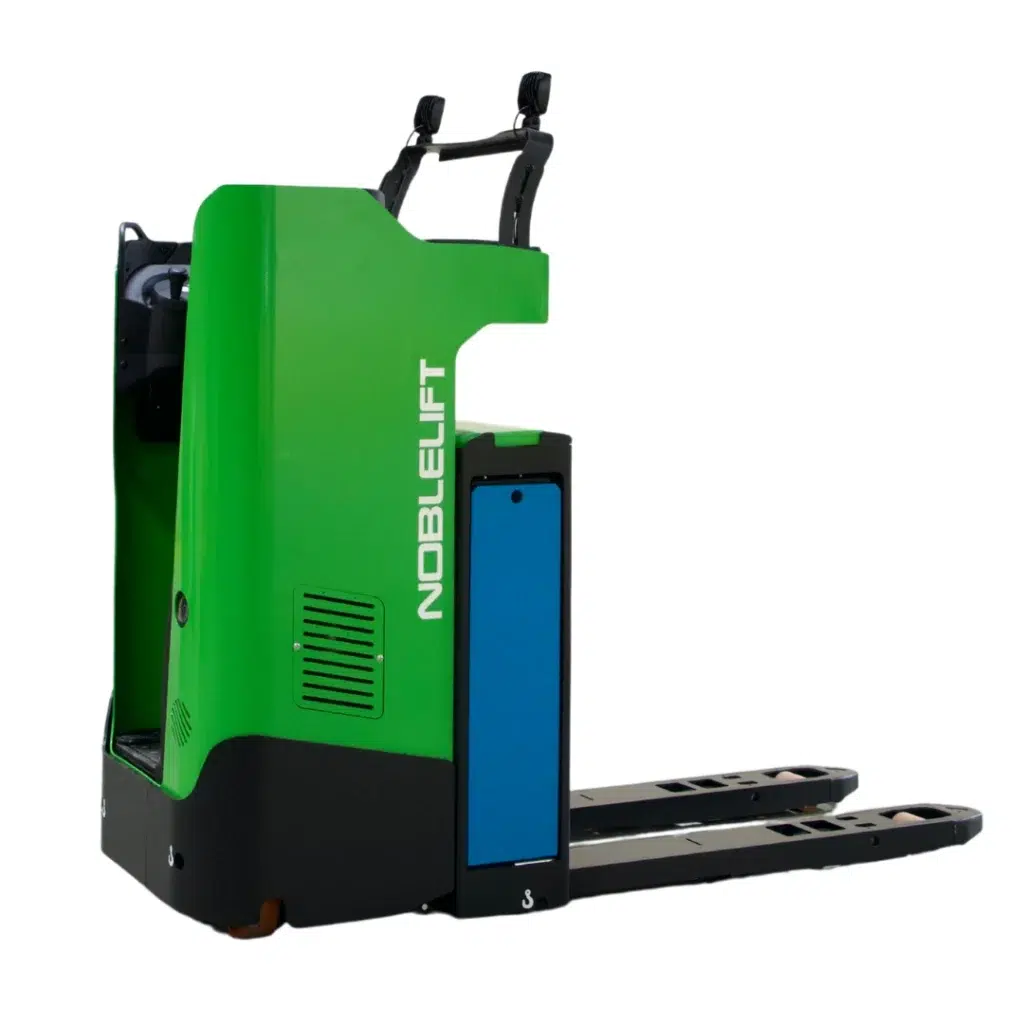
The operator stands sideways on a platform at the powered end, forks trailing. The PT27/36R offers 2,700 or 3,600 kg capacity, forks up to 144″ long for double-pallet handling, and steering assist for easier maneuvering. This is the cross-dock and long-aisle machine.

The operator stands in a compartment between the power unit and the forks, stepping on and off dozens of times an hour to pick cases. Purpose-built for low-level order selection, where the operator handles product rather than whole pallets.
Any of the above with load cells in the forks. A scale-equipped electric pallet mover weighs freight where it’s picked up, which removes the trip to the floor scale. The PTE15N SC handles 1,500 kg with weighing built in, useful anywhere you bill by weight.
| Configuration | Operator position | Typical capacity | Typical speed (loaded) | Best for | Approx. CAD |
|---|---|---|---|---|---|
| Hand pallet truck | Walking, manual force | 2,000 to 2,500 kg | Walking pace | Occasional moves under 15 m | $400 to $900 |
| Walkie Pallet Truck | Walking behind | 1,500 to 2,500 kg | 5 to 6 km/h | General warehouse, backrooms | $7,000 to $16,000 |
| Short tiller | Walking behind | 2,000 to 2,500 kg | Up to 8 km/h | Trailer and container loading | $12,000 to $22,000 |
| Stand-on platform | Riding, forward-facing | 2,000 kg | 8 to 12 km/h | Dock runs, staging, 50 to 150 m cycles | $22,000 to $38,000 |
| End rider | Riding, side stance | 2,700 to 3,600 kg | Up to 14 km/h | Cross-docking, long aisles, double pallets | $32,000 to $55,000 |
| Centre rider | Riding, centre compartment | 2,000 to 3,000 kg | 10 to 12 km/h | Low-level order picking | $35,000 to $55,000 |
All figures are approximate CAD ranges for new equipment and vary by capacity, battery, attachments and dealer. A scale option typically adds $4,000 to $8,000.
Get this wrong and nothing else on the spec sheet matters.
Standard forks are 1,150 mm (45 in), which suits both the 1,219 x 1,016 mm (48 x 40 in) GMA pallet common in Canadian DCs and the 1,200 x 1,000 mm metric pallet. Half pallets and retail display units want 800 to 900 mm forks. Double-pallet handling on an end rider needs roughly 2,400 mm.
Start with capacity. Weigh your heaviest routine pallet, not your average one, then add headroom, because running at 95% of the capacity plate every cycle shortens hydraulic and motor life. A 2,000 kg (4,400 lb) truck moving 1,400 kg loads all day is correctly specced. Ratings assume a standard load centre, so a tall or deep load changes the effective figure.
Standard outside fork spread is about 520 to 560 mm. Wide-spread fork configurations are available for oversized loads, but fork spacing should always be confirmed against the pallet dimensions and direction of entry.
Finally, ask for overall chassis length and turning radius, then go measure your tightest real spot: the trailer nose, the freight elevator, the back corner of the backroom.
Lead-acid still works, but it wants ventilation, watering and a change room once you go multi-shift, which is where the five-year cost comparison between lithium and lead-acid usually flips. NobleLift’s lithium range offers fast charging, opportunity charging, reduced battery maintenance and longer cycle life compared with traditional lead-acid solutions. In many multi-shift applications, opportunity charging can also reduce or eliminate the need for battery changes.
In freezer applications, confirm the truck and battery are rated for the temperature and ask about condensation management when the unit cycles between the freezer and a humid dock. This is where Canadian buyers get burned by equipment specced for milder markets.
For trailer and container loading, look for a compact overall truck length and turning radius. Both short-tiller and compact walkie designs can work well depending on the chassis dimensions. Maneuverability is one of the most important requirements.
Order picking calls for a centre rider with a low step-in height and long forks for two-pallet picking. Pick rate per hour is an important consideration, along with operator ergonomics and the application’s travel requirements.
Cross-docking justifies an end rider at 2,700 to 3,600 kg, high travel speed and double-pallet forks, because distance and pallet count carry the capital cost.
A retail backroom or small warehouse wants a compact walkie, 1,500 to 2,000 kg, on polyurethane wheels, with lithium if the receptacle situation is awkward. Cold storage wants a cold-rated walkie or rider with sealed connectors and a battery chemistry that tolerates the temperature.
Multi-site operations should standardize on one or two models across sites, for common parts, common training and one set of spares. NobleLift’s national accounts program and Canada-wide dealer coverage exist for exactly this, and try-before-you-buy is available to those accounts.
A hand pallet truck uses a hydraulic hand pump for lifting and the operator’s body for travel. The powered version motorizes both, so the operator only steers. It can improve productivity and reduce the physical effort required to move heavy pallets, particularly as travel distances and pallet volumes increase, and requires documented operator training. The hand unit costs a fraction as much and needs almost no maintenance.
Approximate CAD ranges: $7,000 to $16,000 for a walkie, $12,000 to $22,000 for a short tiller, $22,000 to $38,000 for a stand-on, and $32,000 to $55,000 for an end rider or centre rider. Lithium packs and scale systems add to those figures. Prices vary by dealer and configuration, so treat these as planning numbers rather than quotes.
Check the capacity plate and hour meter first. Then inspect load wheels and drive tire for flat spots, look for hydraulic weeping, test lift and lower through the full stroke, and confirm the battery’s age. Ask for service history and confirm parts availability for that model in Canada.
A 24 V, 150 to 210 Ah pack typically covers a standard single shift of moderate walkie duty. Heavy ramp work, cold temperatures and long travel distances all shorten that. Lithium supports opportunity charging during breaks, so one pack per truck usually covers multi-shift operations.
There’s no provincial licence, but operators must be trained and evaluated on the specific class of truck under CSA B335-15 (R2024), which provincial OHS legislation references. Training must cover the equipment, the workplace and a practical evaluation, with records kept. Enforcement sits with your provincial body: WorkSafeBC, MLITSD, CNESST, Alberta OHS and their equivalents.
Most walkies are rated for 6 to 8% grade loaded. Confirm the loaded gradeability figure rather than the unloaded one, and specify initial lift so the forks stay level crossing dock plates and uneven yard slabs. For steady ramp duty, step up to a rider with a larger traction motor.
The fastest way to avoid a mis-specced electric pallet jack is to measure your actual aisles, trailer depths, pallet weights and travel distances before you sign anything. NobleLift Canada’s team will walk your site, size the configuration to your duty cycle, and put approximate CAD numbers against each option, including the cases where a hand pallet truck is still the honest answer.
